
The Venice-Murano crossing by vaporetto relies on an ACTV fare system that has some subtleties, especially since the reshuffling of schedules in autumn 2026. Here, we detail the pricing mechanisms, the lines to prioritize, and the operational points of caution that most guides overlook.
Tap-to-pay and best fare ACTV: the fare you pay depends on the validation channel
The ACTV network has deployed a contactless payment system that goes beyond simply replacing paper tickets. By validating with a bank card, smartphone, or smartwatch, the traveler activates a mechanism for automatic calculation of the best fare. The system aggregates validations over a given period and adjusts the amount charged accordingly.
This changes the game for the Venice-Murano connection. A traveler making several round trips in one day without having purchased a pass may find themselves charged at the rate of a daily pass, without having explicitly chosen it. We recommend checking the bank statement afterward: the final amount does not always correspond to the arithmetic sum of the validations.
If you compare the Venice Murano ferry prices between prepaid passes and tap-to-pay, this technical constraint weighs heavily in the calculation.

Vaporetto lines to Murano: 4.1, 4.2 and their route differences
Lines 4.1 and 4.2 serve Murano from the historic center of Venice by making a circular route, with intermediate stops at Fondamente Nove and sometimes Lido. This route allows for combining a visit to Murano with a stop at Burano or Torcello.
Travel time varies significantly depending on the line and direction of travel. Lines 12 and 13 are other options for reaching Murano, particularly from Fondamente Nove. The choice of line depends on the starting point and desired connections.
Be cautious about the stops on Murano itself. The island has several docks (Colonna, Faro, Navagero, Museo, among others). Depending on the line and direction of travel, the vaporetto does not serve all stops. To reach the glass museum or the workshops in the center of the island, Murano Colonna and Murano Faro are the most relevant stops.
Murano Colonna A and B docks: suspensions due to acqua alta
ACTV indicates that the Murano Colonna A and B docks may be suspended between 8 PM and 7 AM during acqua alta episodes. Lines 4.1 and 4.2 are then rearranged, with alternative routes that extend the journey or eliminate certain stops.
This risk mainly concerns the low season (autumn, winter). A valid ticket or pass does not guarantee access to the intended dock. We advise checking real-time ACTV alerts before an evening trip to Murano.
Autumn 2026 schedules: what has changed since September 14
Since September 14, 2026, ACTV has implemented a new schedule known as “autunnale.” The frequencies on the lines serving Murano have been adjusted, with intervals generally longer than in the summer period. Any schedule published before this date should be considered obsolete.
The official source remains the ACTV website, which updated its tables on September 25, 2026. Third-party applications (Google Maps, Moovit) may show a delay of several days before incorporating these changes. During the transition period, we regularly observe discrepancies between the schedule displayed online and the actual passage of the vaporetto.
For a round trip Venice-Murano without surprises, here are the points to check:
- Consult the ACTV schedule directly on the official website, not on a third-party aggregator, especially after a seasonal change
- Check the acqua alta alerts for the time slot 8 PM – 7 AM if you plan an evening visit
- Identify in advance the Murano dock corresponding to your destination (Colonna, Faro, Museo) to avoid unnecessary walking on the island
ACTV pass or single tickets: decision based on the length of stay
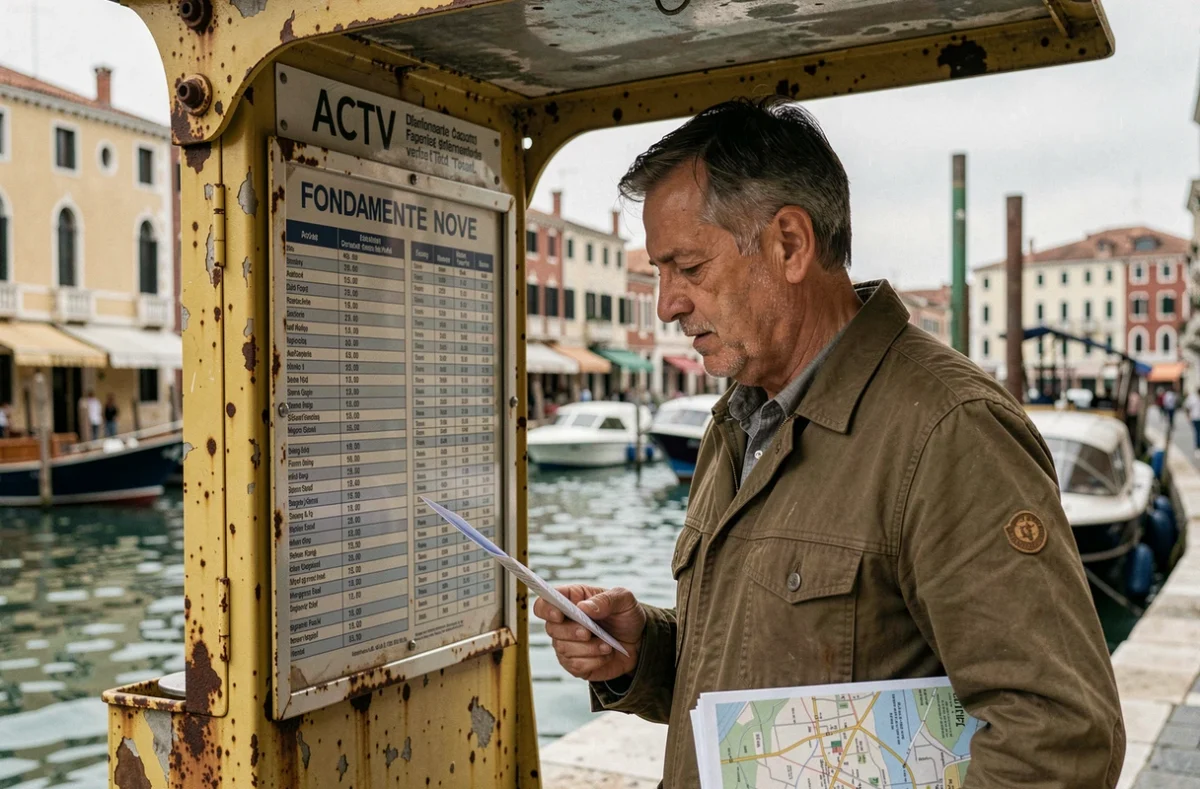
The single ACTV ticket covers a limited validity period after the first validation, regardless of the number of stops. For a simple round trip Venice-Murano in one day, two single tickets are sufficient. The daily or multi-day pass becomes cost-effective as soon as you combine Murano with other islands (Burano, Torcello, Lido) or use the vaporetto for your travels within Venice itself.
The transport pass covers the entire ACTV navigation network, including the lagoon lines. There is no specific “Venice-Murano” ticket at a reduced rate. The distinction is made only on the validity period of the pass, not on the destination.
The best fare mechanism mentioned earlier complicates the calculation. A traveler who consistently validates contactless may sometimes pay less than with a pass purchased in advance, depending on the actual number of trips made. The reverse is also true for intensive use over several days.
Resident and visitor fares
Residents of the municipality of Venice benefit from a fare system that is radically different from that of visitors. The resident fare for an identical trip is a fraction of the visitor price. This distinction explains the often-cited discrepancy in forums between the “real” cost and the “tourist” cost of the crossing.
The resident ticket is not accessible to tourists, even with a long-term reservation on Murano. Verification is done through an ID card or proof of residence during onboard checks.
The Venice-Murano vaporetto connection remains a short journey on paper, but the final cost depends on rarely aligned variables: payment channel, seasonal schedule, dock conditions. Checking the official ACTV schedule on the day of travel avoids most disappointments.