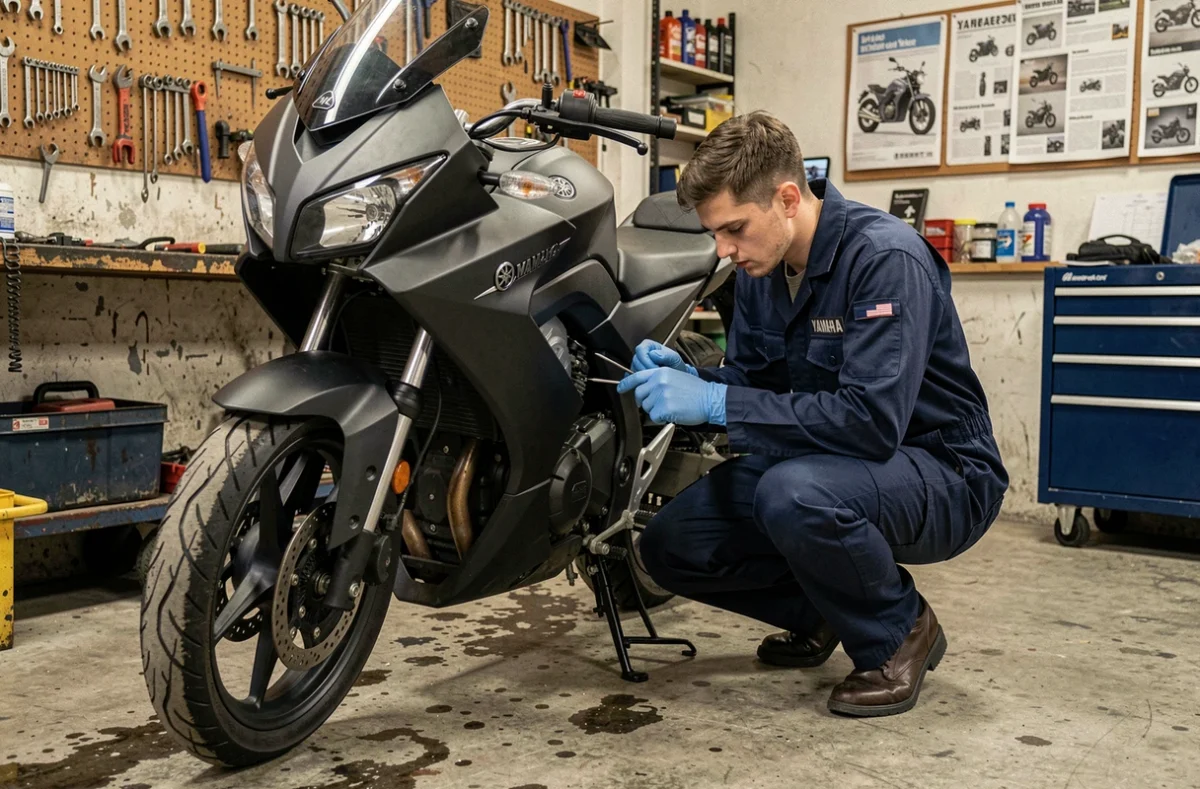
On departmental roads, the MT 125 often tops out around 110 km/h on the speedometer, sometimes less when going uphill or into the wind. For an A1 license holder who rides daily, this limit can become frustrating, especially during overtaking or merging onto fast lanes. Increasing the performance of this Yamaha involves several interventions, but each has mechanical, legal, and financial consequences that cannot be ignored.
Registration and motorcycle insurance after modifying the MT 125
Before touching the engine or exhaust, one must address the administrative question. This is the point that most online guides gloss over, while it conditions everything else.
The DREAL Auvergne-Rhône-Alpes specifies that any modification of a system or equipment of a registered vehicle (engine power, exhaust, braking, tires, lighting) can affect the conformity of the certificate of conformity. Resuming circulation may then require a single vehicle approval (RTI) from the DREAL.
In practical terms, if one modifies the power or exhaust system of their MT 125, they must go through the manufacturer or their authorized representative to obtain the conformity documents. These documents then allow for the update of the registration certificate. Without this process, the motorcycle operates with characteristics that no longer match its registration document.
On the insurance side, an undeclared modification can lead to a denial of compensation in the event of an accident. The insurer relies on the declared characteristics of the vehicle. If the actual configuration differs, there is a risk of dispute. It is recommended to inform one’s insurer before any intervention, even for a simple exhaust change.
To understand in detail how to achieve the unrestricted top speed of the MT 125, one must first master this regulatory framework; otherwise, performance gains can turn into legal problems.

Transmission and output sprocket: the most accessible lever
On a four-stroke 125 like the Yamaha MT 125, the engine delivers power limited by its displacement. One cannot magically double this power. However, one can modify how it reaches the rear wheel.
Changing the output sprocket (PSB)
The output sprocket is the least expensive and quickest part to replace. Adding a tooth to the PSB favors top speed at the expense of low-end acceleration. Removing a tooth has the opposite effect: better acceleration, but the engine runs faster at the same speed.
For road use where one seeks to gain a few km/h at the top end, a PSB with an additional tooth is generally installed. Feedback on this point varies depending on the condition of the chain and rear sprocket, but the principle remains the same.
- PSB +1 tooth: gain in top speed, loss in low-speed responsiveness, ideal for long trips
- PSB -1 tooth: better acceleration, engine revs up faster, suitable for city use
- Simultaneous replacement of the chain and sprocket recommended to avoid premature wear of the kit
This modification does not affect the engine itself. It remains one of the simplest to carry out in a workshop or at home with basic tools.
Exhaust system and air intake on the MT 125
Replacing the stock exhaust with a full system (header + muffler) is one of the most common modifications on 125 motorcycles. On the MT 125, this intervention aims to reduce the exhaust flow restrictions imposed by homologation standards.
What a sports exhaust really changes
An aftermarket exhaust improves the flow of exhaust gases. The power gain remains modest on a 125 single-cylinder, but it is particularly felt in the mid-range. The sound changes more than the power curve, and this is often the real motivation for purchase.
Warning: an unapproved exhaust makes the motorcycle non-compliant with technical inspection and noise standards. This brings us back to the RTI question mentioned earlier. An exhaust stamped with a European homologation number avoids this problem.
Air filter and injection tuning
Installing a less restrictive air filter increases the airflow admitted by the engine. On an injected motorcycle like the MT 125, this modification must be accompanied by a recalibration of the injection mapping. Without this adjustment, the air-fuel mixture becomes too lean, which can lead to overheating or engine failure over time.
This recalibration is done through an additional unit or a reprogramming of the original ECU. In both cases, it affects the engine management system, which may impact the Yamaha manufacturer’s warranty.

Yamaha manufacturer’s warranty and motorcycle derestriction
It is often forgotten, but the manufacturer’s warranty covers the motorcycle in its original configuration. As soon as one modifies a component related to the engine (exhaust, intake, ECU), the manufacturer may refuse coverage in case of a breakdown.
This refusal does not necessarily apply to the entire motorcycle. It targets the components affected by the modification. If one changes the exhaust and the clutch fails unrelated to this modification, the warranty should still apply. In practice, the burden of proof often rests on the owner, complicating recourse.
- Keep the original parts to be able to revert the motorcycle to stock configuration before a dealership visit
- Keep invoices for aftermarket parts and labor to document the interventions
- Check the specific warranty conditions of the Yamaha contract before any modifications
For an MT 125 still under warranty, the most cautious strategy is to limit modifications to reversible ones (PSB, air filter) and wait until the end of the manufacturer’s coverage for heavier interventions.
Reprogramming the MT 125 ECU: additional unit or ECU flash
Electronic derestriction represents the most direct lever to modify engine behavior. Two options exist.
The additional unit connects between the sensors and the original ECU. It modifies the signals sent to the ECU to enrich the mixture or shift the cutoff thresholds. The advantage: it can be removed in a few minutes to revert to the stock configuration.
The ECU flash (direct reprogramming of the ECU) offers finer tuning, but it is irreversible without prior backup of the original mapping. This operation requires specific equipment and a skilled operator. A bad flash can render the ECU unusable.
In both cases, the declared technical characteristics of the vehicle are modified. The DREAL reminds us that this type of transformation requires documentary compliance. Engine reprogramming, even if it is not visible to the naked eye, remains a modification subject to the same rules as a change of exhaust or displacement.
Whether one chooses transmission, exhaust, or electronics, each intervention on the MT 125 involves a trade-off between performance, legality, and mechanical durability. The gain in top speed remains limited by the engine’s displacement, and no modification will turn a 125 single-cylinder into a mid-displacement sportbike. It is better to focus on one or two well-executed modifications than to pile on interventions that cancel each other out.